Red Light Therapy Sydney: Your Essential 2026 Guide (and Where Hyperbaric Oxygen Fits)
Red light therapy Sydney: the evidence, the hype and where hyperbaric oxygen fits
Five years ago, a red light bed was something you saw on a biohacker’s Instagram. Today, a search for red light therapy Sydney turns up day spas, physio clinics and a growing number of gyms. Hyperbaric chambers have made the same leap, from hospital wards to wellness studios.
That’s usually the moment a therapy gets oversold. Every new device arrives with a list of benefits longer than its supporting research.
So here’s an honest look at both: what they do, what the evidence supports, and why neither works well on its own.
The short version: Red light therapy has a solid body of research for muscle recovery and skin, with thinner evidence elsewhere. Wellness-style hyperbaric oxygen is promising but early, and it isn’t the same as the medical treatment used in hospitals. Both make the most sense as one part of a plan built on your own data, not as a shortcut.
What is red light therapy?
Red light therapy, also called photobiomodulation, uses specific wavelengths of red and near-infrared light, roughly 600 to 1,100 nanometres. Unlike UV, it doesn’t tan or burn. Unlike an infrared sauna, the point isn’t heat.
The working theory sits inside your mitochondria. Light at these wavelengths is absorbed by an enzyme called cytochrome c oxidase, which plays a part in how cells produce energy. The idea is that this gives cells a small lift in energy production and helps settle oxidative stress.
Red wavelengths act closer to the surface, which is why they’re used for skin. Near-infrared travels deeper, into muscle.
What does the research say about red light therapy?
The strongest human evidence is in muscle performance and recovery. A systematic review of human trials found photobiomodulation can improve muscle performance and recovery, and that paired with training it may increase muscle gained. Skin is the other well-studied area, particularly collagen and fine lines.
The honest caveat: results vary a lot between studies, because devices, wavelengths, doses and timing all differ. A 2026 review still names inconsistent dosing as the field’s biggest barrier. Claims about weight loss, hormones or brain performance rest on much thinner evidence.
In practice, red light is a reasonable recovery tool for people who train, used consistently. It isn’t a cure-all.
What happens during a red light therapy session?
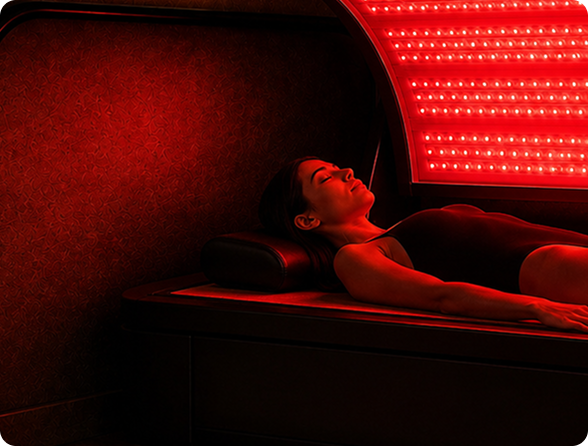
A session is simple. You lie in a full-body red light bed, usually for 10 to 20 minutes, in minimal clothing so the light reaches your skin. Eye protection is standard.
There’s no real heat, no noise beyond a gentle fan and nothing to feel beyond mild warmth. Most people use it after training or on rest days, then get on with their day. There’s no downtime.
What matters is consistency. One session is pleasant. The effects seen in studies come from regular sessions over several weeks.
What is hyperbaric oxygen therapy (HBOT)?
HBOT means breathing concentrated oxygen inside a pressurised chamber. Higher pressure lets more oxygen dissolve directly into your blood plasma, so more reaches your tissues than you’d get breathing normally.
There are two quite different versions, and the difference matters.
- Medical HBOT is delivered in hospitals, using 100% oxygen at pressures well above normal. It’s used for conditions like decompression sickness, carbon monoxide poisoning and some non-healing wounds, under specialist care.
- Mild HBOT uses a lower-pressure chamber, typically around 1.3 atmospheres, with oxygen-enriched air. This is the version you’ll find in wellness and longevity settings.
Recent reviews are clear that the two shouldn’t be treated as interchangeable. Mild HBOT is not a substitute for medical treatment, and anyone with a diagnosed condition should be guided by their doctor.
What does the research say about mild hyperbaric oxygen?
Early, but interesting. Research on mild HBOT has focused on oxidative metabolism: how efficiently your cells use oxygen to make energy. Animal studies have shown improvements in markers of metabolic health, and the lower pressure appears to avoid the oxidative stress linked to higher-pressure treatment (review). Human research in healthy, active adults is still limited.
So treat any promise that a handful of sessions will reverse ageing with healthy suspicion. A fairer framing: mild HBOT may support recovery and energy as part of a broader routine, and for most healthy adults it’s low-risk.
Red light therapy vs infrared sauna vs hyperbaric oxygen
These three get grouped together, but they do different jobs.
| Therapy | What it uses | Main aim | Strength of evidence | What it feels like |
|---|---|---|---|---|
| Red light therapy | Low-intensity red and near-infrared light | Cellular energy, muscle recovery, skin | Moderate for recovery and skin, mixed elsewhere | Lying still in soft, warm light |
| Infrared sauna | Infrared heat | Circulation, relaxation, recovery | Reasonable for relaxation and circulation | Deep, even warmth |
| Mild hyperbaric oxygen | Oxygen-enriched air at mild pressure | Oxygen delivery, recovery, energy | Early, mostly animal and small human studies | Ear pressure like a plane descending, then calm |
They don’t compete. At SOMA, all three sit under one roof, so your protocol can use whichever your results point to.
Who is red light therapy suited to?
Red light tends to suit people who train regularly and want to recover better, people focused on skin health, and anyone building a long-term longevity routine. It’s less suited to anyone after a quick fix for weight loss or a specific medical problem.
Speak to your doctor first if you’re pregnant, have a light-sensitive condition, take medication that increases sensitivity to light, or have a history of skin cancer.
Why don’t these therapies work as a standalone fix?
Because a therapy is only as useful as the reason you’re using it.
Most people come to red light or HBOT the same way. A friend swore by it, they saw it online, they bought a pack of sessions. Then they’re left guessing whether it did anything. Did you sleep better because of the chamber, or because you had a quieter week?
Without a baseline and a way to measure change, there’s no way to know. It’s the same problem we’ve written about with fragmented health advice: one more tool on the pile, and nobody connecting it to the rest.
The better question isn’t “does red light therapy work?” It’s “is this the right tool for my body right now, and how will I know?”
Red light therapy Sydney and HBOT: how they fit into SOMA Longevity
In SOMA Longevity, the red light therapy bed and hyperbaric oxygen chamber aren’t extras you buy by the session. They’re part of a personalised protocol built from your results.
It starts with understanding: a 75-biomarker blood panel, DNA testing, epigenetic age analysis and your Oura Ring data. Your Tomorrow, SOMA’s partner team of longevity doctors and naturopaths, takes you through it and helps shape your plan. If your inflammation markers or recovery data point that way, red light and HBOT may feature heavily. If they don’t, they won’t.
They also sit alongside the rest of SOMA’s Recovery Centre, all included: the traditional Finnish sauna, the infrared sauna and the magnesium cold plunge.
Then you retest. Twice-yearly bloodwork and ongoing wearable data show what’s actually shifting, so your protocol is refined on evidence, not habit.
Frequently asked questions
Is red light therapy the same as an infrared sauna?
No. An infrared sauna uses heat to warm the body, which supports circulation and relaxation. Red light therapy uses specific wavelengths at low intensity, without meaningful heat, aimed at processes inside your cells. They do different jobs and work well together.
How often should you do red light therapy?
Studies use a wide range of protocols, often several sessions a week over a number of weeks. Consistency matters more than any single session. In SOMA Longevity, your frequency is set by your protocol and adjusted as your results change.
Is mild hyperbaric oxygen therapy safe?
For most healthy adults, mild HBOT is considered low-risk. The most common side effect is ear pressure, similar to flying. Anyone with ear, sinus or lung conditions, or who is pregnant, should speak to a doctor first. SOMA Longevity includes suitability screening and medical oversight through Your Tomorrow.
Can red light therapy or HBOT slow ageing?
There’s no strong evidence that either therapy slows ageing on its own. What they may do is support recovery, energy and tissue health, which all feed into how well you age. Tracking biomarkers and epigenetic age over time is how you see whether your overall approach is working.
Red light therapy Sydney CBD: where can I try it with hyperbaric oxygen?
SOMA Longevity at SOMA Collection, Aurora Place, includes a red light therapy bed and hyperbaric oxygen chamber as part of a personalised, medically supervised protocol. The program is taking Founding Waitlist registrations now.
The right tools, for the right reasons
Whether you’re new to red light therapy Sydney-side or already a regular, the principle is the same. Red light and hyperbaric oxygen are most useful when you know why you’re using them, and can see what they’re changing.
SOMA Longevity will open with a capped number of Founding Memberships. Join the Founding Waitlist to hear first when applications open.
Read more
What Your Bloodwork Actually Tells You About Your Fitness (And What It Doesn’t)
Blood tests for fitness: the markers behind your training, recovery and long-term health Your last blood test came back normal. Good news.…
Longevity in Sydney: Why Our Co-Founder Tested It First
Longevity is everywhere in Sydney right now. Every week brings a new supplement, a new device, a new protocol someone swears by.…
Gym with Sauna in Sydney: The Smartest Way to Train and Recover in the One Place
Looking for a gym with sauna in Sydney? Soma Collection offers premium training and infrared sauna recovery under one membership in the…
Why Reformer Pilates is Sydney’s Most In-Demand Workout (And Where to Try It in the CBD)
Discover why reformer pilates is Sydney's fastest-growing workout. Book a class at Soma Collection in the CBD and experience the difference.
